
It is pretty well-known that CO2 represents only one part in 2500 in the atmosphere. Water vapor represents one part in 40. Not only is CO2 a wimpy constituent of the atmosphere, it is also a wimpy constituent of the green house gasses.
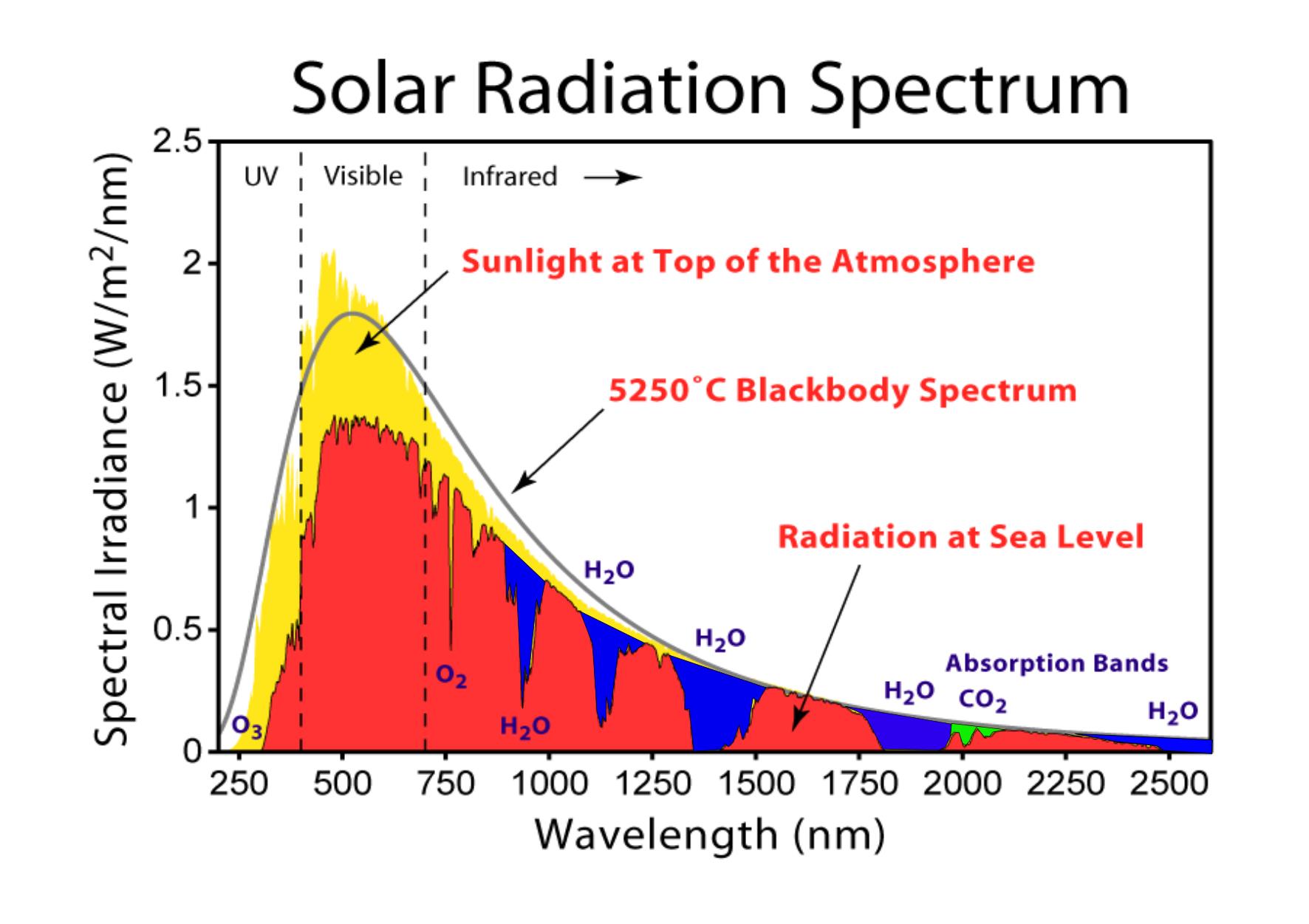
I was looking at this Wikipedia graph of the solar spectrum for another project. It shows the bands and energy levels with notches in the radiation at sea level where greenhouse gasses absorb the incoming radiation. I took the liberty of filling the water absorption notches blue to highlight them. I highlighted CO2 green.
These very same bands operate in reverse on the earth’s reflected radiation back to space, giving us in aggregate half of our greenhouse effect. What can I say? CO2 is a wimp!
P.S. 2-21-14:
Took a notion to digitize the graph above. Scaled the red area of solar insolation to 1. The blue water absorption holes have an area of .15. The Green CO2 absorbtion area is .005. The units on the Y axis are watts per square meter. Wikipedia says “direct” sunlight reaching the surface is 1050 watts/square meter, but when you add in “indirect” it goes up to 1120. It is not clear if this extra 70 includes back radiation from the greenhouse gasses.
Let’s just call it 1120. By our ratios above we get 168 watts/square meter from water and 5.6 watts/square meter from CO2. Together they amount to 174 watts/square meter absorbed by “top down” radiation. This absorption warms the atmosphere.
When you look closely at the graph that some of the bites out of the spectrum by greenhouse gasses go all the way to zero and some do not. When you point a meter at the sky and some light gets through in a green house band the band is saturated and allowing some photons through. It is also reflected photons. Your meter can’t tell the difference. When your meter reads zero in a band, you have a black hole kicking gas and taking names.
This is where the incoming greenhouse effect is really strong. The H2O bites around 1300 and 1900 microns are not saturated. Carbon dioxide is.


 geosciencebigpicture

Pingback: Everyone Loves Lists, Should We Worry or Not? | geosciencebigpicture
I really appreciated the simplification of this. Have you also done this for the outgoing radiation. I was wondering if this is too hard given waters dominance and Co2, methane, and NO2 are so small?
Incoming and outgoing radiation are different animals. Incoming radiation from the sun is shorter wavelength and higher energy and tends to cause “electronic” transitions in what it hits. These are when an electron is bumped to a higher energy shell. Outgoing radiation from the earth is longer wavelength and lower energy and tends to cause rotational and vibrational transitions where the electrons stay put.
Please see “The 2 Good Greenhouse Gas”. CO2 is not a wimp by any means in the outgoing spectrum. In fact, it is the victim of its own success.
My apologies for the slow response. I have been preoccupied.
Is this an exercise in globalization and uniformitarianism? I agree with what gymnosperm says about incoming radiation and with the original contention that CO2 is a wimp. Just ask yourself, how much of the global surface emits energy at the narrow band of wavelengths that CO2 absorbs in and for how much time of the day and year and then multiply that by 0.04%. After doing that you’d have to be mentally challenged to continue to believe in the AGW hoax. You can look me up on Quora to find out how astronomical influences drive climate cycle at time scales down from the Milankovic cycles.
Carbon dioxide is a wimp as regards absorption in the incoming solar radiation which this post addresses. This is good because a considerable part of incoming solar radiation is reflected back to space from clouds and dust and the surface. This reflected part passes through the atmosphere twice, both in and out.
Carbon dioxide is not a wimp as regards outgoing earth radiation. The entire surface of the earth emits radiation in the CO2 absorption bands, and the strongest absorption in the CO2 fundamental bend sits very near the peak of the earth’s outgoing LW intensity curve.
The reason CO2 does not control climate at any time scale despite strong absorption is that it absorbs so strongly in the fundamental bend and surrounding rotations, it saturates within a meter and adding more causes no further reduction in surface radiation to space. These bands were saturated before humans came along. Adding CO2 only causes reduction in surface radiation to space in the weak peripheral bands. Saturation in the super strong bands near the surface does NOT prevent CO2 from radiating very strongly to space from the stratosphere in these same bands. The CERES satellite sees earth radiation to space slightly increasing.
Let’s not forget that of the 1380 W/m^2 of the solar constant at the top of the atmosphere, only about 1000 W/m^2 reaches the ground. The generally overlooked answer is that water vapor refracts and reflects light across the entire solar spectrum as shown on the Wikipedia page for “rainbows”. (https://en.wikipedia.org/wiki/Rainbow) When there is more water vapor in the air, less light reaches the ground. When there is a lot of water vapor, we see it as ‘clouds’ and solar panels stop producing electricity. Fewer cloudy days means higher daily highs. With the global winds slowing down, less water vapor is coming ashore.
“Near-surface wind speeds over landmasses across the planet have dropped by as much as 25% since the 1970s, and climate scientists are taking note.”
https://cosmosmagazine.com/climate/the-wind-is-slowing-down/
What is causing this? I’ll give you a hint.
“Wind power capacity worldwide reaches 650,8 GW, 59,7 GW added in 2019”
https://wwindea.org/blog/2020/04/16/world-wind-capacity-at-650-gw/
650.8 GW * 25% charge factor / 45% efficiency * (86400 * 365.2419) seconds per year / the total mean mass of the atmosphere (5.1480 x 10^18 kg) is 2.216 J/kg/year for the entire atmosphere.
Have a nice day.
Interesting. So you are saying windmills are slowing the wind and warming the land? You went a bit fast for me at the end. A simple guy like me needs to know if ~2.2 J/Kg/yr is the kinetic energy we remove from the atmosphere with windmills, what is the “natural” kinetic energy of the atmosphere before windmills in the same units for comparison? Reducing the equator/pole temperature gradient also reduces winds.
A wind speed of 7 m/s (15.66 mph) has 0.5 * (7^2) = 24.5 J/kg [K = 0.5 mv^2]
Prior to wind farming, the average kinetic energy of the earth’s entire atmosphere was 131 J/kg for the northern hemisphere and 170 J/kg for the southern atmosphere. A 1993 wind survey at 50 meters listed a global average of 6.8 m/s.
Dear James,
You creates an interesting theory there: Windmills heat our atmosphere.
But this theory is nonsense: Wind dissipates via friction and is continually transformed into heat. Solar radiation is the driving force for generating winds: the sun heats the earth surface and the heat gradients create wind. To understand global warming, we have to consider the energy balance between solar radiation heating earth and earth’s heat emission cooling earth. Over extended periods of time, it does not matter whether some of that energy is stored in winds.
The CO2 absorption is indeed very small as compared to that of water. But it does reduce the earth’s emission by a tiny bit — sufficient to increase the surface temperature by a little. And that effect accumulates over time, until earth is hot enough that the earth’s blackbody emission makes up for that extra retained energy. That little effect from CO2 may add up to a percent or two of warming — and going from some 288 degrees Kelvin to 294 Kelvin (2% increase) will make life quite uncomfortable for most of us.
Hope this helps you understand our global warming problem.
It is not nonsense. Everything that dissipates energy is a factor. Wind across any surface transfers energy away. Think wind chill factor. Where it goes depends on where the wind is headed.
why you comparing this to the suns spectrum ratehr than the earths thermal radiation spectrum?
co2 affecting the suns radaition very little and the earths thermal radiation a lot is kinda the whole working principle here
Water works both coming and going. CO2 is a wimp in outgoing absorption as well.
ummm
dude
working both coming and going would make it an ineffective greenhouse gas
I don’t think you entirely grasp the very basics of the working principle of the phenomenon you are attempting to talk about
Water is a very effective greenhouse gas. It absorbs and transfers energy to the atmosphere both from incoming SW and outgoing LW radiation. You appear stuck with the grade school notion that GHGs work like the glass in a greenhouse. According to the Wood Experiment, greenhouses don’t even work like the grade school notion
Even grade school level seems beyond the scientifically illiterate and incurious majority who accept images of the dominant temperature regulating gas, water vapour, the white clouds from cooling towers labeled as “carbon pollution spewing”.
The visualization of water vapor’s absorption compared to CO2 was very insightful.