Postcard from a resltess mind

What level of economic growth is sustainable? In the current environment probably the anemic growth we are seeing, but capitalism has always been a boom and bust thing with a mentality that if you aren’t growing like crazy you are dying. The older I get the stupider this seems.

The latest Wells Fargo economic report said that the Federal Reserve and the Obama Administration had decided that there can be no dramatic increase in growth until housing construction recovers. Huh? What do we need more houses for? The emerging immigrant middle class perhaps, but besides the immigrants the demographics are all downhill. The postwar generation is senescent and will be vacating houses for the foreseeable future. The pathetic message here is that housing construction is the last bastion of Joe six-pack American manufacturing. Computer numerically controlled, CNC, machines will take over much of new housing just as they have taken over the rest of successful American manufacturing.

So what is sustainable? Not Joe six-pack. He will remain a ward of the state or his family. Not Keynesian stimulus programs that  prime the pump when the pond is dry. First, we need to fill the pond.
Posted in Economics, Geography | Tagged , , , | Leave a comment

Of Carbon and Sodium

Carbon is really starting to remind me of Sodium. Not that Sodium gets my hands dirty or greasy or anything. Most people have never even seen Sodium, it’s really weird stuff. But just a few years back everyone was getting it out of our diet. Cereal boxes were labeled with Sodium content by decree. Low Sodium this and low Sodium that and Sodium isn’t even bad for you. It is Chlorine or Chloride that should be labeled. Yet a generation of nutrition students went on to become government regulators with the misconception burned in.

And now we have Carbon taxes and Carbon footprints and another generation of students. All I know is that if I have Carbon footprints, I make sure to wipe my feet before going in the house.

Posted in Climate | Tagged , , , | Leave a comment

Viejo indeed! When the big dog stirrs…

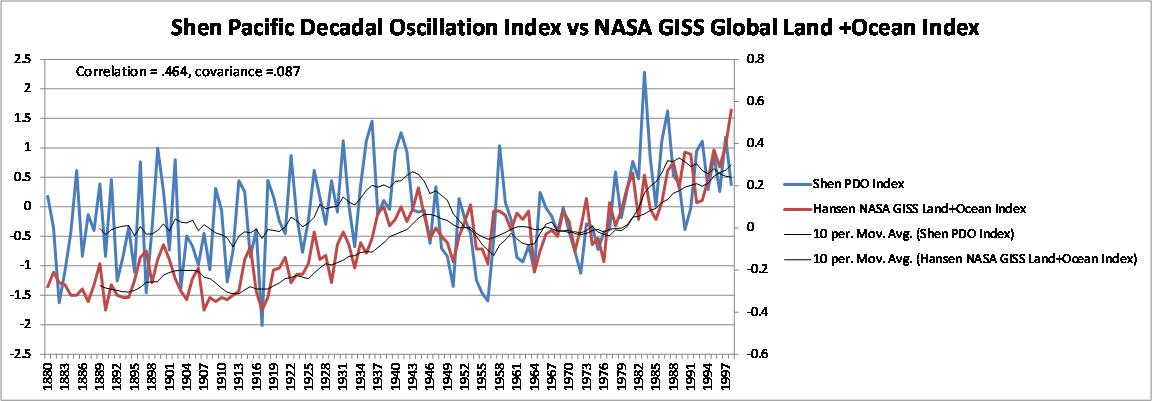
El Viejo, (the old one) is an alternative name developing for the La Niña phase of the El Nino Southern Oscillation, ENSO. Much has been written on the impact of ENSO on global temperature, and many are coming to understand the importance of the Pacific Decadal Oscillation, PDO, in both controlling the likelihood of Nino/Viejo events in the ENSO subcycle and in affecting global temperature directly.

Here I have plotted Jim Hansen’s land +ocean data available at GISS against a remarkable PDO index from Caining Shen et al that I found while bushwhacking through the National Climate Data Center site. This index goes back to AD 1470 and it correlates very well with the more familiar Mantua and NCDC multivariate indices.

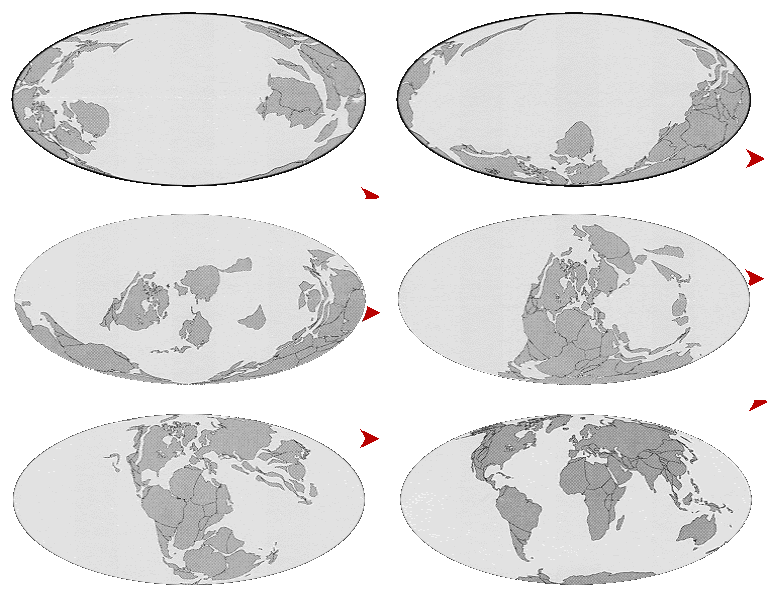
The Pacific oscillations, PDO and ENSO, result from the unequal and alternating upwelling of deep water pumped in to the Pacific by the thermohaline circulation. Alex Van de Sande did a beautiful all-ocean view of the thermohaline circulation available under a creative commons license.

All Ocean view by Alexandre Van de Sande

The bottom water in this circulation mixes so poorly with shallower waters that it can be isotopically identified in the Pacific after travelling 25000 miles from the North Atlantic, down to Antarctica, around the circum- Antarctic current, and up.

Fewer appreciate that the bottom water upwelling in the Pacific oscillations today is about a thousand years old. It was sinking in the North Atlantic during the Medieval Warm Period while the Vikings were settling Greenland (and wreaking havoc in Europe).

The big dog is an old dog, maybe a third of the oceans by volume, and whatever else may force global temperature, there is a thousand-year supply of this cold water already in the pipeline, a supply  with a temperature and chemical signature imprinted when it first sank in the North Atlantic.

Posted in Climate, Climate Change, Geography, Global Warming, Oceanography | Tagged , , , , , , , | 1 Comment

528 years of PDO, the long skinny one.


Quite a bit lost in the upload but here is the complete Shen Index plotted on three graphs and cobbed together (Excel tops out at 255 per series). Most of the time the index has been negative. The 10 year moving average shows a major dip in the 1550’s and a decent spike in the 1620’s. Picked a ten year moving average because it’s supposed to be a decadal oscillation, but I see nothing decadal here.

The major action besides the wild climb in the late 1400’s is the climb to the peak about 1940, the descent to a deep negative, and the rise during the global warming era to the highest positive in the index about 1998. Seems headed down now…

Posted in Climate, Climate Change, Geography, Global Warming | Tagged , , | Leave a comment

And so goes PDO…

The first thing one notices is that this historical index shows the Pacific Oscillation to be far more medicentennial than decadal. This bears some further work for this wonderful index:

 Shen, C., et al. 2006.
Pacific   Decadal Oscillation Reconstruction.
IGBP   PAGES/World Data Center for Paleoclimatology
Data   Contribution Series # 2006-045.
NOAA/NCDC   Paleoclimatology Program, Boulder CO, USA.

goes back to 1470, about when Columbus was learning to walk.

The second thing one notices is that PDO is not a good way to predict rain in San Francisco.

Posted in Climate, Climate Change, Geography | Tagged , , , | Leave a comment

Without data, there is only religion

Well here it is, finally, after hours of optical character recognition to extract the data from :

Null, Jan, “A Climatology of San Francisco rainfall, 1849-1991”  (1992). Master’s  Theses. Paper  490. http://scholarworks.sjsu.edu/etd_theses/490

data that should be readily available through the publicly funded Western Regional Data Center and the National Climate Data Center, but are not, the first fruit of the labor.

This shows the three years in the record where San Francisco had less that ten inches of seasonal rainfall against the average and the 2011 season so far. 1897, 1975, and 2011 so far show a pattern of early season above average rain, a midseason drought, and modest recovery late in the season. The California mid-season dry spell has been noticed by many observers, even in normal years. The first mention I recall was by David Brower in his MANUAL OF SKI MOUNTAINEERING, written in the 1960’s. With the data this can be explored.

Interesting the 1897 season had a spike in May. The last three years San Francisco has had above normal rain in May and even into June. Ah, the possibilities.

Just try going to the NCDC site! The earth has warmed the last thirty years and that is the only data available. You are invited to view evidence of supposed increase in extreme events, evidence of the icecaps darkening,  diminished sea ice. All these things are true and predictable from a rise in global average temperature, but if you want data of extreme events before the warming era, well, those languish undigitized in the National Archives.

It would be easier to indulge the gospel according to Jim Hansen so evident at NOAA if they would free the data!

Posted in Climate | Tagged , , | Leave a comment

Data follies continue

During the gold rush in 1849 a couple of doctors and an interesting character, a surveyor/glass blower/instrument maker, began taking rainfall measurements in San Francisco. They sold this data to local newspapers and an almanac. In 1871 the army signal service began official recordings.

In spite of the fact that the US GOVERNMENT has recorded the precip data since 1871 the data does not appear to be available from the NCDC. They refer you to the National Archives, of which only a small portion has been scanned.

While cruising the NCDC site I did find an extremely cool ENSO index based on rainfall records from northern China from 1470. It seems one can get index from pre-columbian (yes, that is 22 years before Columbus sailed the ocean blue) rainfall data from China but nothing from late ninteenth century San Francisco!!

Posted in Climate | Tagged , , , | Leave a comment

What is going on here?

I was going to do a little excel graph plotting a nice el nino/viejo index readily available from the Japanese Meterological Association (JMA) from 1864 to present against precipitation for the same period in the San Francisco area. I am quite certain that SF precip data are available somewhere since at least 1848. I was appalled to find that it is virtually impossible to get simple historical climate data online. It strikes me that we have spent millions if not billions of dollars funding the National Climate Data Center and like state agencies. This information should be readily available.

Try googling “precipitation data for (your town) from 1860 to present”. What I get is a few irrelevant sites for extreme weather events, current condidtions, and maybe a reference to the NCDC. The National Climate Data Center clearly does not want to dispense the raw data, which in my opinion is their charter.

The google tally very quickly segues to global warming this and climate change that. Exactly the tone of the NCDC site . I’m not asking for an opinion, just give me the data.

The problem seems to boil down to the notion some in the scientific community have that they are uniquely qualified to read and interpret the scripture. Like the Catholic Church in the Middle Ages, they would have us  kneel in the knave while they drone in latin…

Posted in Climate, Climate Change, Geography | Tagged | 1 Comment

Climate Change

Been getting up to speed on what I feel is the salient geoscientific issue of our time. We really need to get this one right. The stakes are enormous and the emotional pitch of the climate war is increasing.

On one side we have 1970’s computer geeks and their scientific progeny who have done an enormous amount of valuable work synthesizing the efforts of previously disconnected fields of oceanography, climatology, geology, astronomy, ecology, and the paleo versions of the former; and reduced much of this to physics and mathematical formulae that can be used in computer models. The models and the formulae have had considerable success replicating second and third order emergent properties of the ocean-atmospheric circulation. They have parlayed this success into prominent positions in NASA and the equivalents in western governments, and they warn of impending disaster if fossil fuel burning continues apace.

On the other side, lead scientifically by geologists and paleo folks with a long-term perspective, aided by skeptical statistical analysts, and aligned with successful business people attuned to pragmatic risk analysis; many argue that the computer models are inaccurate, the risks overblown, and that the costs of mitigation vastly exceed the costs of the problem.

One can understand the emotional pitch. One side earnestly believes it is saving the planet, and the other side that it is saving our way of life, and the possibility that the rest of the world can ever enjoy our standard of living.


Posted in Climate | Leave a comment

How to get your arms around a billion years

Any dog knows that humans have very poor senses of hearing and smelling. We don’t have a very good sense of time either. We really have no sense of our own lifespan, let alone a billion years.

Our planet is thought to have condensed from a dust cloud about 4.2 billion years ago. We used to think there was about a billion years of peace on earth before life germinated, but it keeps getting pushed back to 3.6 and maybe 3.8 billion years ago. I find myself thinking that a mere half billion years from the formation of the planet to the beginning of life is surprisingly short, given how inhospitable it was back then. I am actually thinking that a half a billion years is short!

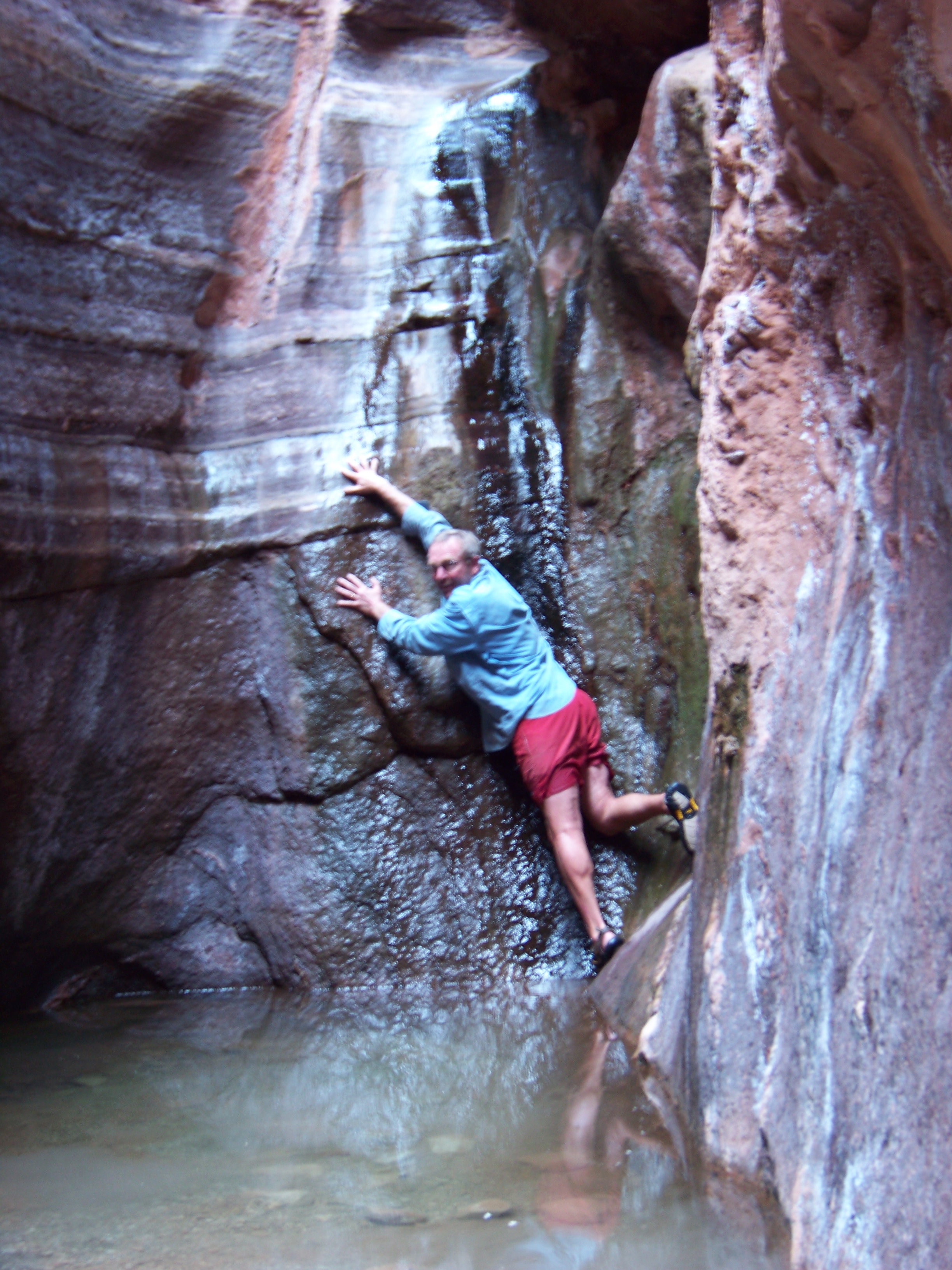
Here is a picture of a crazy guy with his arms around 1.2 billion years in the Grand Canyon.

The layers of sediments are about a mile deep and they can be read like a book, but a lot of pages have been torn out here. This happens when an area is uplifted for a while and the sediments get washed off.

There is just enough time in the billion years remaining for life on earth for a mountain range like the Rockies to be buried under a mile of sediments, for a river to cut down through it, and for some unimaginable creature with a better sense of time than ours to ponder it.

Posted in History of Life | Leave a comment