YGBFkiddinme, Low Emissions Grass?

From Nature Magazine this pearl of pulchritude:

“The solution, says Michael Peters, an agronomist at CIAT and leader of the team that has developed the low-emissions grass, is to encourage ammonium to persist in the soil for longer, by suppressing microbial activity. Farmers can buy synthetic nitrification inhibitors such as dicyandiamide, but these are not ideal. The chemicals can be washed away, and it would be impossible to target them to where they are needed most — where grazing animals have left urine and dung that act as extra fertilizer.”

Enter, stage left, a clown, to explain that when we fertilize our agricultural plants, many of which such as corn, wheat, etc., are C4 grasses; we also fertilize the soil microbes.

Note to clown: photosynthesizing organisms also produce some level of Carbon dioxide by their own respiration. Why do you think they go to the trouble of photosynthesis?

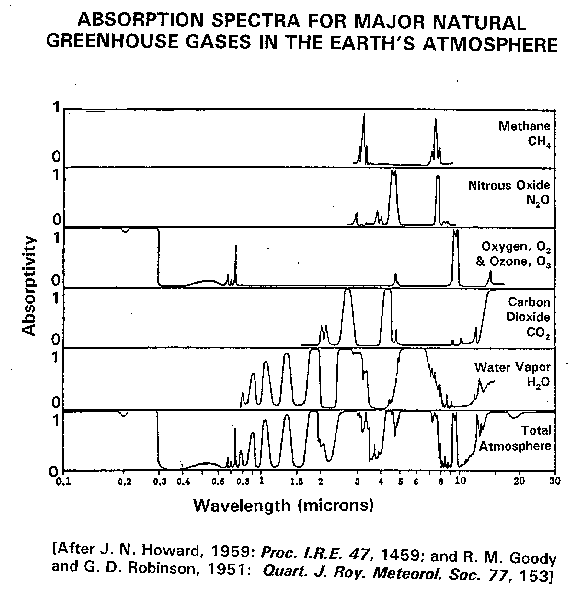
But this misguided effort seems targeted at Nitrous oxide. Microbes eat rocks. They have permeated the crust of the earth as least as deep as our deepest boreholes. They will definitely exploit any extra ammonium nitrate we give them. While nitrous oxide in a jar may be 300 times more efficient at absorbing and radiating infrared photons than Carbon dioxide, its concentration in the atmosphere is over 1000 times lower.

Exit clown, stage right.

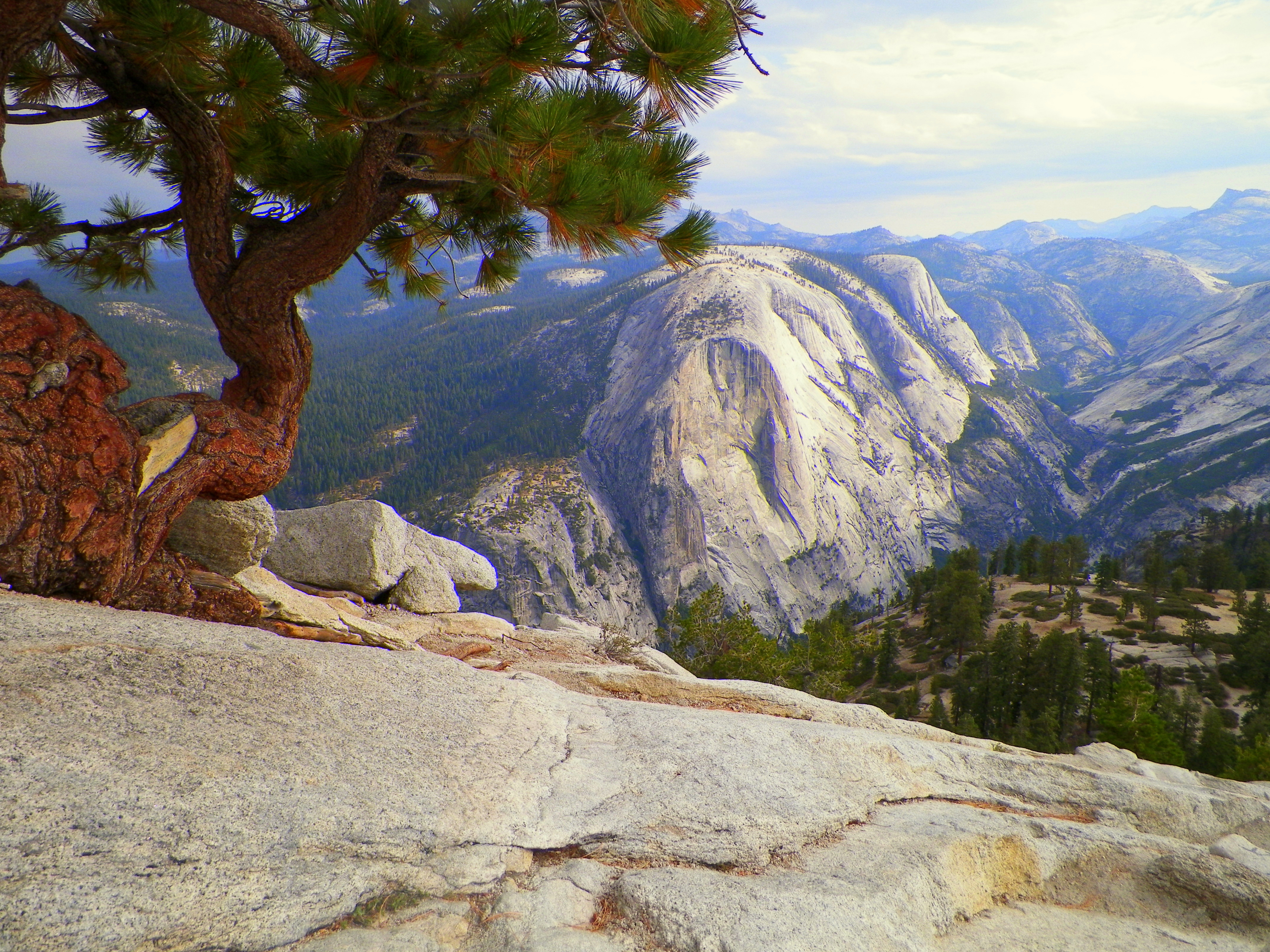
1_13763_P1020346Low Emission Grass

Photo Credit: Nature

There seems to be some effort to find other greenhouse gasses to villanize as it becomes increasingly apparent that Carbon dioxide has been ridiculously oversold. Yet the failure of the lower atmosphere to warm for the last decade and a half casts doubt on the harmfulness of all greenhouse gasses.

These folks have found a grass from Africa that produces a natural microbicide. This is not surprising as many plants produce chemicals, including herbicides to inhibit competition.

What is alarming is the inclination to interfere with the decomposition of ungulate excrement. The relationship between ungulates and grasses has been stable since they coevolved 30 million years ago and has been a staple of the ecosystem since grasslands expanded as the earth fell into the glacial period we live in about 2.5 million years ago.

Enter stage right, a scientist, with heavy glasses, remaining near the curtain, to mention that the cyanide based fungicide, dicyandiamide, might have deleterious consequences.

Exit scientist.

Please see Salvation from Cows.

BTW, nitrous oxide is laughing gas. LOLOL

Posted in Biology, Carbon Cycle, Climate, Climate Change, History of Life, Microbial Dark Matter, Paleoclimate, Salvation from Cows, What's going on here? | Tagged , , , , , , | Leave a comment

Gravity Signals of Extensional Sialic Crustal Regimes

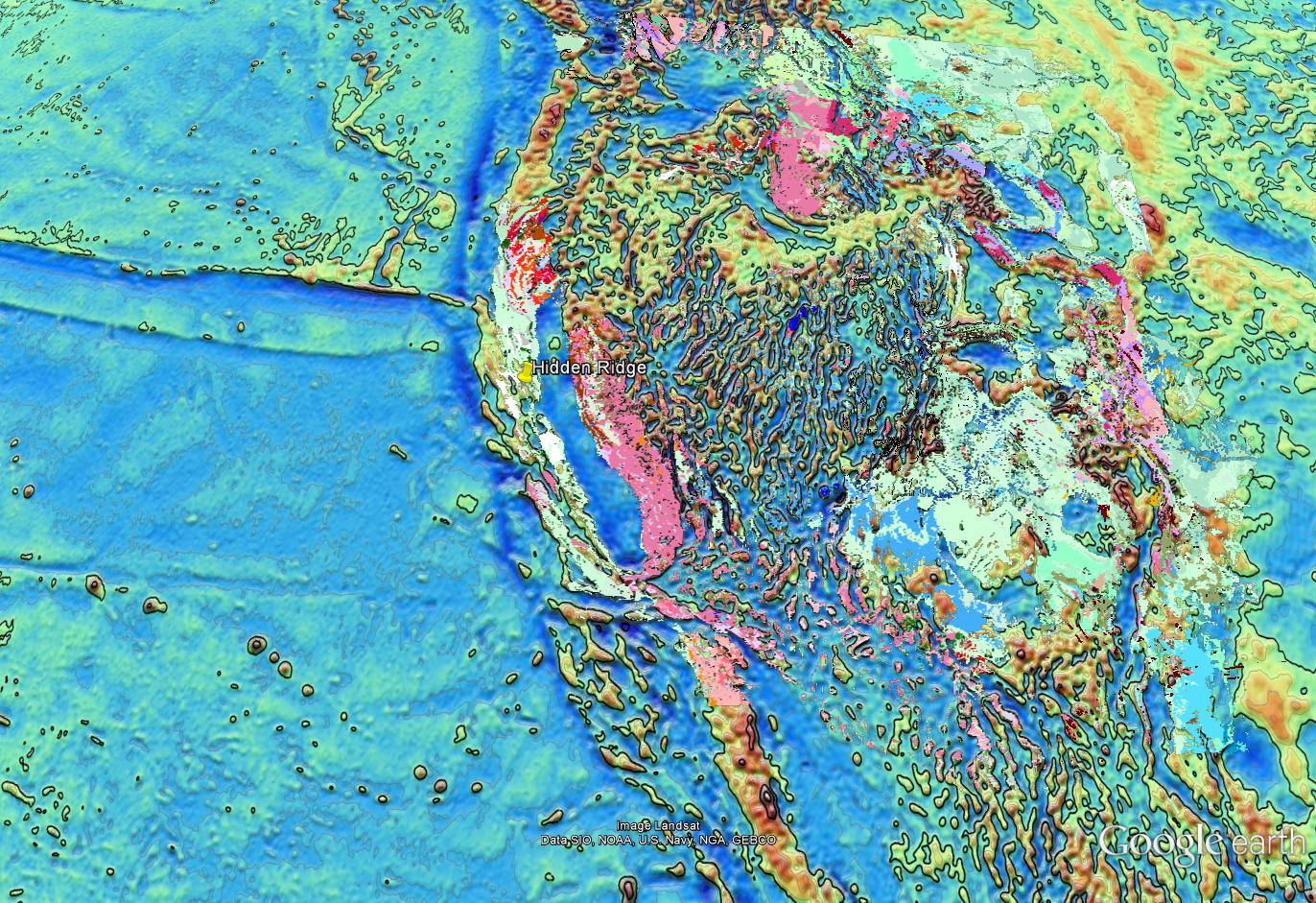
I have always loved the poorly named Great Basin of the Western United States. Yes, its maze of lowlands held a lot of glacial meltwater during the last glacial maximum before letting it percolate out to the Columbia and the Sea of Cortez, but this “basin” probably averages more than 5000 feet above sea level and it is definitely arched in the middle.

Great Basin

The gravity signal we propose defines the Great Basin as a heart shaped feature bounded clockwise by the Sierra batholith, the Snake River “Hot Spot” volcanics, the Wasatch Front, the Colorado Plateau, and I would argue the Salinian/Transverse Ranges. This definition would include the Mojave Desert even though this province is far more granitic.

The signature is textured, often linear high gravity “horsts” interspersed with low gravity “grabens”. This poses an interesting question because if we take the conventional view that an even crust was uplifted and stretched, it is not clear why the horsts should float any higher on the mantle. The answer must be that the crust was not even and the horsts are toy sailboats with keels of more fractionated material.

Very few places on earth bear this signature. One rather nearby is the Canadian Cordillera.Canadian Cordillera

This region is not commonly thought of as extensional, but the paleomagnetism does not match the geology for western North America and it seems reasonable to suppose that complex dextral movement has taken place further inland, possibly involving the prominent linear gravity low along the Proterozoic continental margin.

Another such area is greater Mongolia. Here, possibly as a result of the impact of India, rotational extension below the Baikal rift zone has created a similar signature.

Mongolia

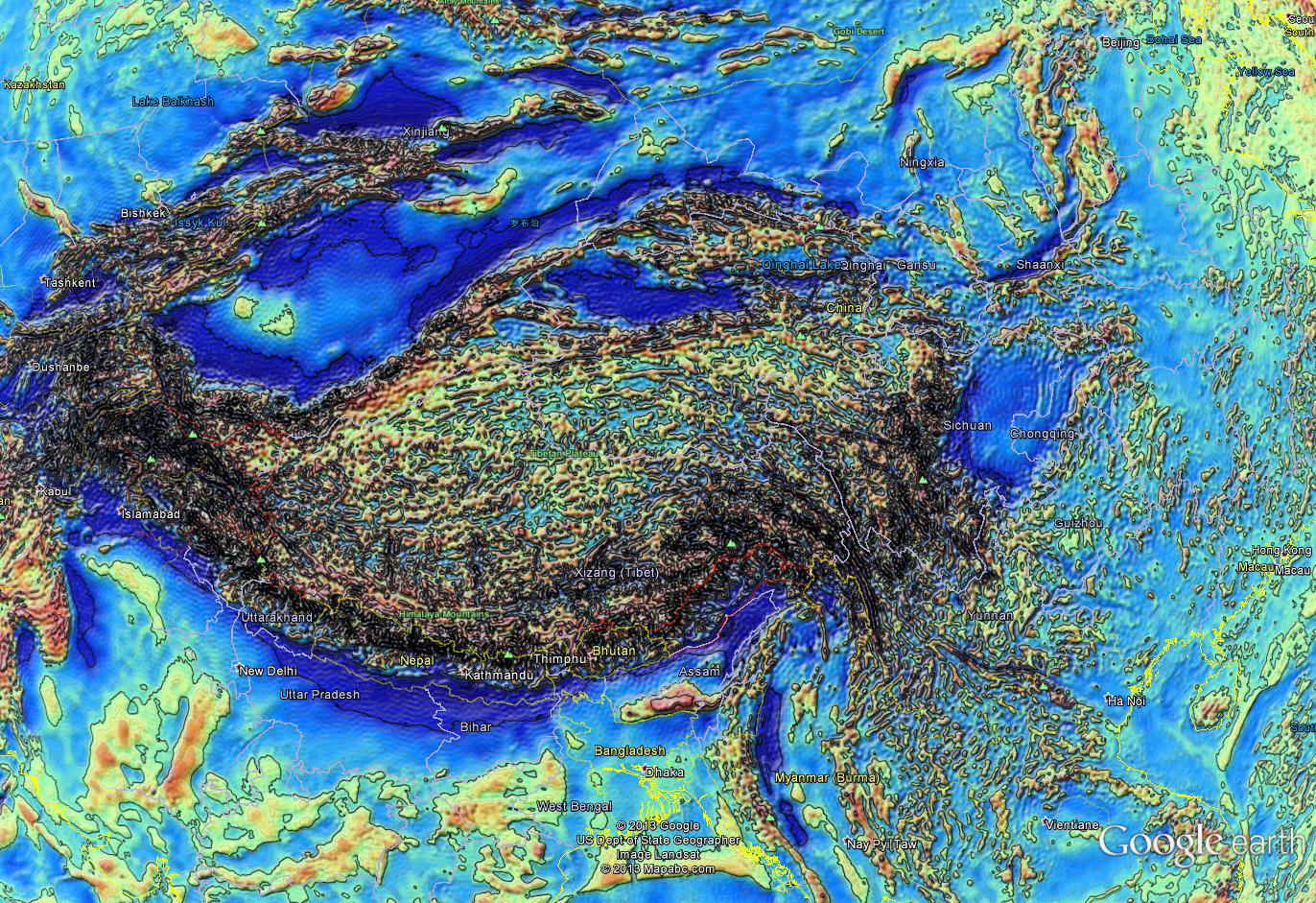
Yet another area is the Tibetan Plateau.

Tibetan Plateau

It is nearly heresy to suggest extension here, and indeed the compressional areas are very clear, reading as black. Nevertheless, the plateau and large areas of Malaysia and Southern China show the distinctive pattern.

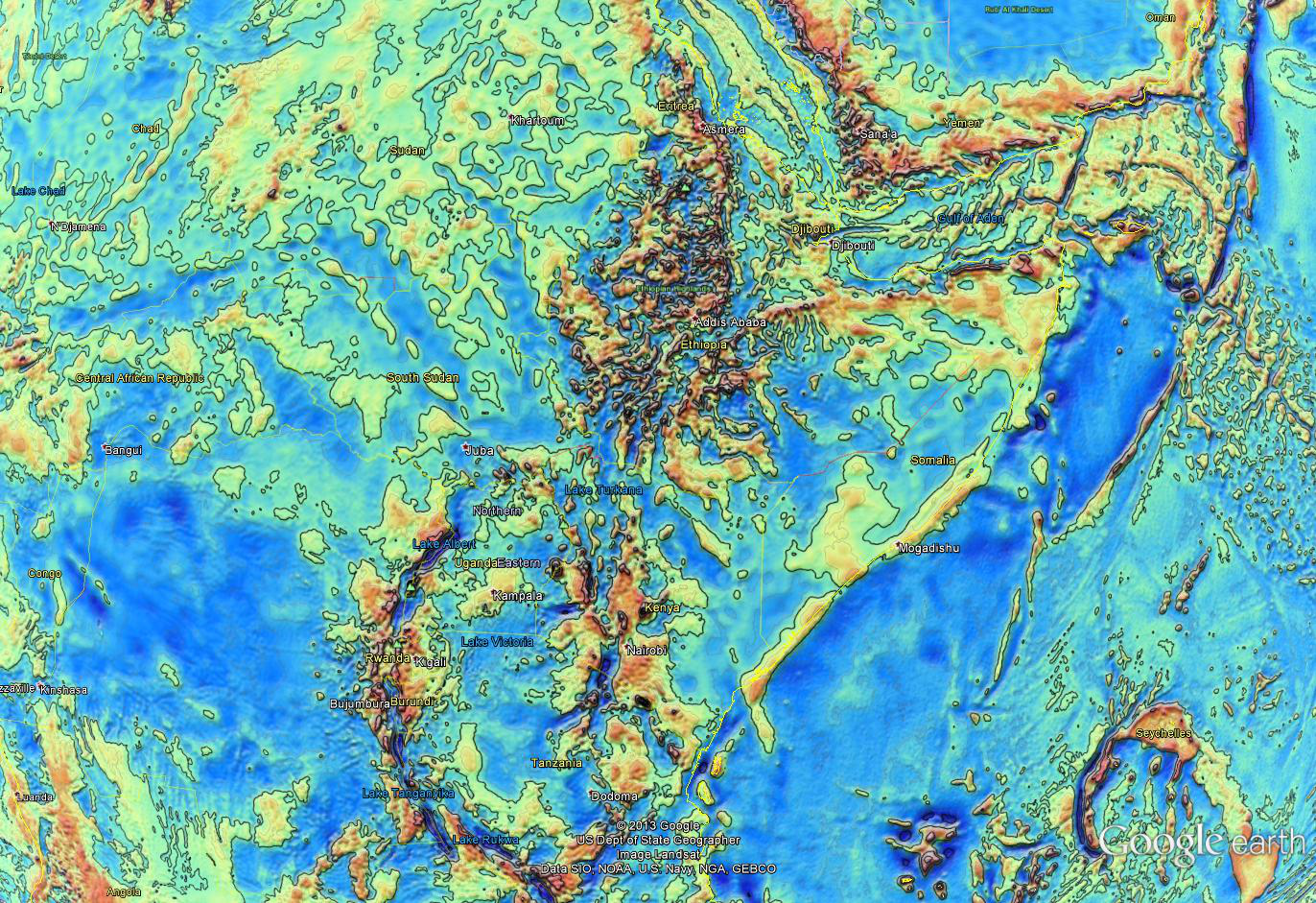
Finally, let’s look at the African rift zone.

African Rift

It is interesting that the pattern here seems restricted to the highlands of Ethiopia and the more famous mountainous areas further south seem very different.

Posted in Geography, Geoid, Geology, Gravity Anomalies, Plate Tectonics | Tagged , , , , , , , | Leave a comment

The Hawaiian/Emperor Seamounts and How Island Arcs are Formed

Ever wonder why offshore island arcs should form at random spots in the oceans? No? Don’t worry, its a far fig newton.

We offer here the suggestion that the locations are not random, that island arc trenches and probably spreading ridges and transform systems as well, form where tectonic stresses exploit a hot and thin weakness scribed in the crust by recent passage of a hot spot.

Hawaiian Emperor Island arc

Check out the Hawaiian/Emperor seamount chain in relation to the North Pacific trench systems on a gravity map. This seamount chain is an island arc/trench system waiting to happen. If push comes to shove the western concave side will fail and begin sliding under, forming a Benioff zone like the  ones shown by red depth contours in the nearby Aleutian trench.

The Hawaiian hot spot is essentially a cutting torch from below. It is a point source of volatile components from the mantle. As it burns through ocean crust it reprocesses and further fractionates it leaving a slag of lighter and more buoyant islands in its wake. An island arc really couldn’t ask for more. The volcanic conduits are already in place! If compressive forces should cause the Western Pacific ocean floor to start sliding under, it would begin distilling hydrated ocean floor into aluminized intrusives and granite, and possibly join the island arcs that have been accreting to western North America since the Cambrian.


Posted in Geography, Geology, Gravity Anomalies, Seamount Chains as Incipient Island Arcs | Tagged , , , | 1 Comment

Granite Rafts

Continents are granite rafts.

We believe that granite is formed when thoroughly hydrated ocean floor sinks at a subduction zone or trench, often at the edge of a continent. When it sinks deep enough it gets cooked at very high temperature and pressure, and the more volatile components rise and intrude into the rock above, forming volcanic mountain ranges or island arcs. Within these volcanic mountain ranges granite forms, to be exposed only after the overlying more volatile volcanics are eventually washed away.

101_0085

There were bits and pieces of continents earlier, notably the nascent continents of Australia and Africa, but there really wasn’t much granite around before about 2.7 billion years ago, possibly because there wasn’t enough water to make much of it.

So essentially once the ocean basins filled enough to hydrate granite formation the continents have steadily grown by accretion of granite to their present size and the process continues today.

Granite and Felsic Intrusives of the Western US with Tertiary Volcanic and Sedimentary Surface Expressions Removed

Here is the surface distribution of granite in the Western United States shown on a gravity map. The gravity represents the total mass between the measuring satellite and the center of the earth. In the dark blue areas of low gravity there is either more water and less rock, for instance along the prominent Mendocino Fracture Zone in the Pacific Ocean, or less dense or thinner continental rock sections, such as the California Great Central Valley and many smaller interior basins.

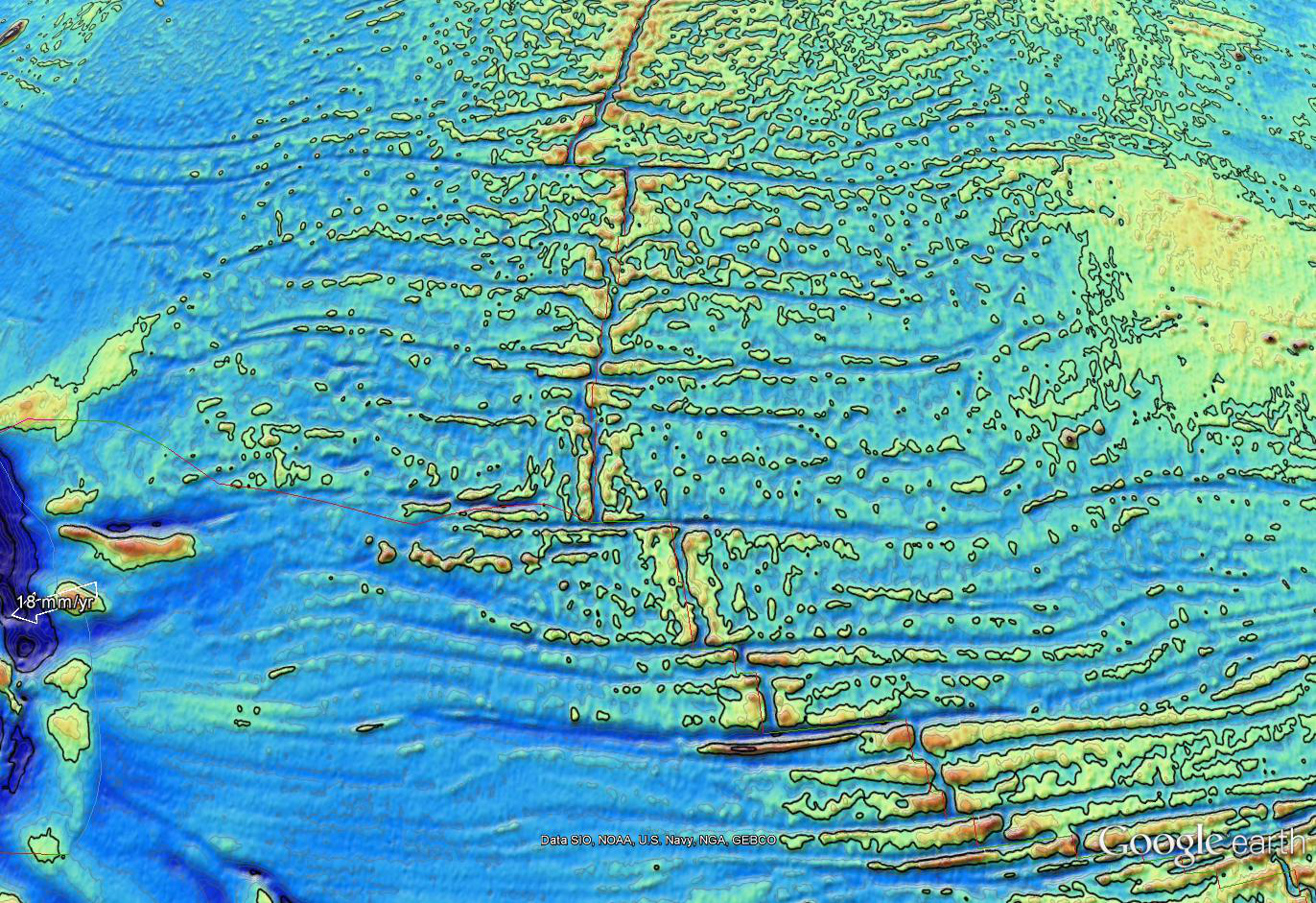
It is notable that the Sierra Nevada granite batholith and the trench that created it (the Central Valley) are bounded by the Mendocino and Murray fracture zones in the Pacific. It is as if the section of ocean ridge or spreading center (since overridden) between these fracture zones was entirely responsible.

Fracture zones often offset segments of ocean spreading ridges like this picture of the Atlantic Ridge. The offsets accommodate different spreading rates between segments and the curvature of the planet.

Fracture zones

The concept of individual spreading segments matching individual granite batholiths may help us understand the sprinkling of small batholiths throughout the Western U.S.

The continents are granite rafts because they are comprised of lighter, more volatile Aluminum silicates distilled from ocean floor rich in the heavier and less volatile silicates of Iron and Manganese. Both the ocean floor and the continents ride on the viscous mantle. The continents just float a little higher.

Posted in Geography, Geology, Gravity Anomalies | Leave a comment

Dude, It’s Not About Carbon Dioxide

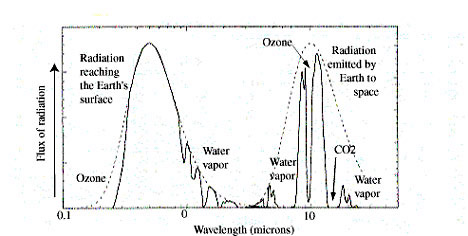
We know a lot about Carbon dioxide in a jar. We know the wavelengths it prefers to absorb and emit photons. We know it tends to mix efficiently with other gasses. We know it has a nearly magical affinity for cold water.

Spectrum budgetGreenhouse absorbtion spectrum

We have known these things for a long time. What we still do not know is exactly how this gas representing 1/2500 of the atmosphere by volume (1/2000 by mass) acts in the earth’s biogeochemical/atmospheric/oceanic system.

A decade and a half ago when the satellites told us the atmosphere was warming quickly and human Carbon emissions were increasing at about the same slope, it was reasonable to worry. I worried.

Several lines of high quality evidence developed in the last fifteen years now indicate that Carbon dioxide is not a major problem:

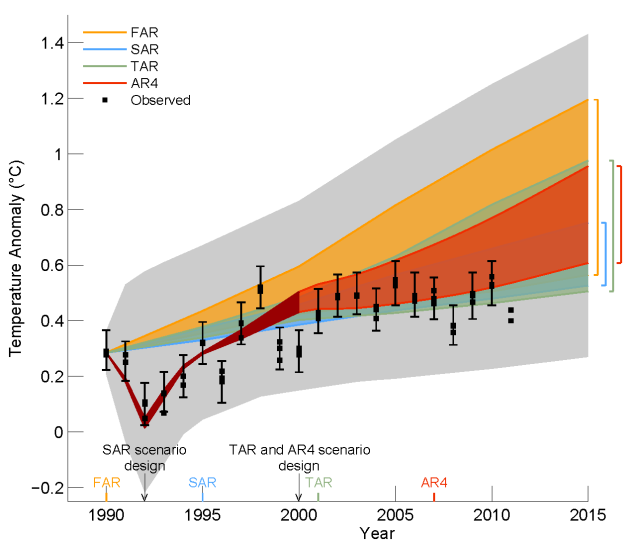
1. All four satellite groups agree that there has been little, if any warming of the lower atmosphere in the last sixteen years, in spite of accelerating human CO2 production.

ipcc_ar5_draft_fig1-4_with

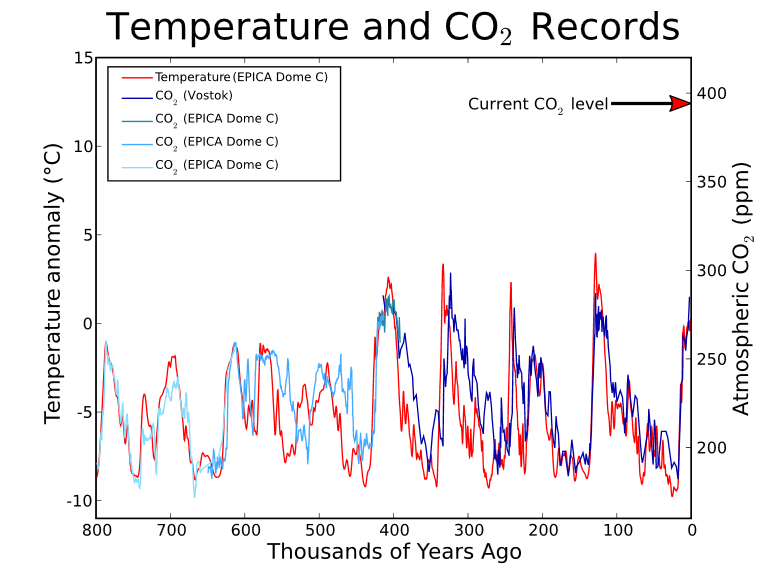
2. Bubbles in ice cores have shown very clearly that atmospheric temperature has led CO2 into and out of every glacial/interglacial cycle at both poles like a poodle on a leash for the last 800,000 years.

Co2-temperature-plot

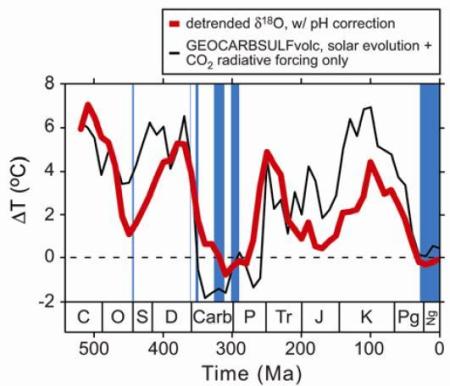
3. Multiple  improved measurement techniques indicate that Carbon dioxide the earth’s atmosphere over the history of life has been ten times higher than it is now, and that glacial periods have occurred nonetheless.

Royer_2009_present_smaller

4. It has become standard practice to pump CO2 into commercial greenhouses at five times current atmospheric concentration.

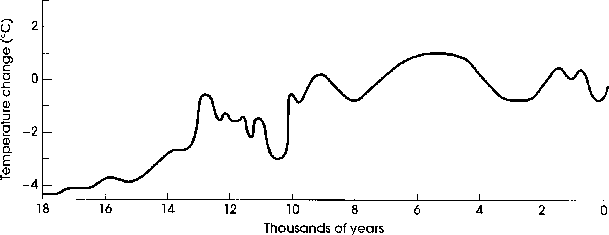
5. It has become clear that the rapid warming of the atmosphere documented by satellites from the late seventies to the late nineties is far from unusual and that two periods since the last glaciation experienced equal rates of warming and higher atmospheric temperatures than today.

fig1

The hard truth is that we just don’t know how our planet works. Any number of things we are doing may be our undoing, just as any number of things we eat may be killing us. We just don’t know. We will eat, and we will burn, making decisions at every turn with imperfect information. We must use science to give us the best possible edge, and right now all the evidence is saying, “Dude, it’s not about Carbon dioxide”

Posted in Carbon Cycle, Carbon Dioxide Loves to Swim, Climate, Climate Change, Global Warming, Paleoclimate | Tagged , , , , , , , | Leave a comment

The Alpine Zone and the Colonization of Land, or Plants Make Dirt

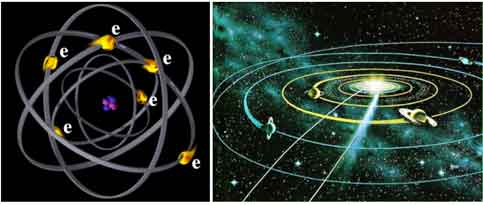
There have been several concepts that have no predictive value in an era of reductive science, but nonetheless contain poetic truth. One of these is the notion that the atom is a microcosm of the solar system, the galaxy, and possibly the universe. You will not be able to predict quantum properties of atomic particles with this model, but there remains something fundamental about lighter objects spinning around concentrations of mass.

bofc8

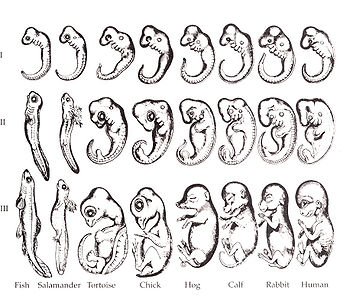
Another of these poetic concepts is ontogeny repeating phylogeny, the notion that the development of a complex organism from a single cell repeats the evolution of complex organisms from single cellular life forms. Once again, you will be unable to make specific predictions, but there is obviously something fundamental here.

350px-Haeckel_drawings

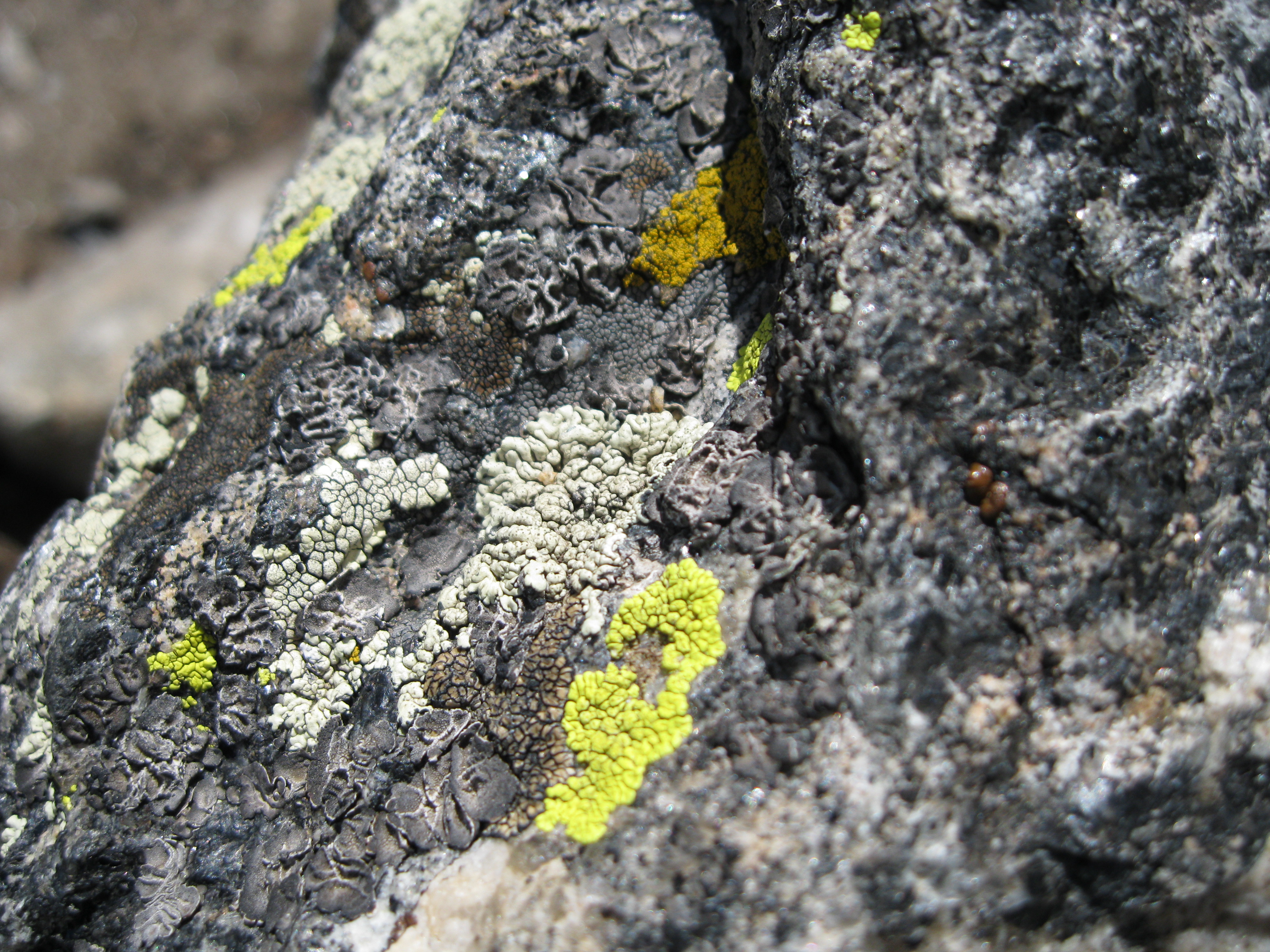
My intention is to submit another fundamental notion: that a trip to the alpine zone is a trip back in time, perhaps 2.5 billion years, to conditions similar to the seashore at that time as photosynthesizing creatures first washed out of the oceans to live on land.

I have always loved the alpine zone because one can sleep on the ground and roust about climbing and never get dirty. The reason for this is very simple, there is no dirt. The reason there is no dirt is there are no plants. Plants make dirt.

In the alpine zone today we find lichens, business partnerships between fungi and either alga or photosynthesizing bacteria. The microbes have been businessmen for a very long time. There is evidence for similar partnerships between photosynthesizing and filamental bacteria and between bacteria and alga.

12-lichen-a

Eating rocks is a tough business to be in, and it is even tougher on land than under water. Call the alpine zone the final frontier in the colonization of land.

Posted in Biology, Geography, Geology, History of Life, Metaphor, Wilderness | Tagged , , , , | Leave a comment

I Deny

“Denier!”, in the tone of apostasy. Well, call me the apostate, because I deny. I deny that there is any reasonable scientific evidence that Carbon dioxide will cause catastrophic global warming. I deny this as a naturalist and serious student of geoscience.

I believe that although we have a very good understanding how Caron dioxide behaves in a jar, that this understanding does not translate to the earth systems.

I further believe that current human Carbon dioxide production will have no effect beyond its proportion of the natural carbon cycle (5%) and may well be far less due to negative feedbacks.

I further believe that we live in a glacial period and the biosphere is Carbon dioxide limited. Our Carbon dioxide production will green the planet just as it has greened our commercial greenhouses for decades at five times the current atmospheric level.

https://geosciencebigpicture.com/2012/07/15/carbon-isotope…-the-biosphere/

“Carbon Prohibitionists”, I respond to my accusers.

Global Warming and Prohibition

I deny. I deny. I deny.‎

Posted in Biology, Carbon Cycle, Carbon Dioxide Loves to Swim, Carbon Prohibitionists, Carbon Theology, Climate, Climate Change, Global Warming, Global Warming Denial, Religion | Tagged , , , , , , , | Leave a comment

The Personal Digital Assistant (PDA) and the Apple of Eden

We were camping in Eastern Oregon the night before a raft trip near the put in for Hells Canyon. It was a popular campsite and I noticed a young man with a striking tendency to put his hand to his ear in normal (non electronic) interactions as if he were talking on his cell phone. A naturalist notices these things.

We humans are visual creatures. We see colors. We distinguish between ripe and unripe fruit without bothering to taste it. Our eyes guide our fingers to the ripe fruit bobbing from the wind or our disturbance of the branches. We are mesmerized by dancing colors.

In the early 1950’s black and white television became color television.

220px-The_Childrens_Museum_of_Indianapolis_-_Philco_Predicta_television

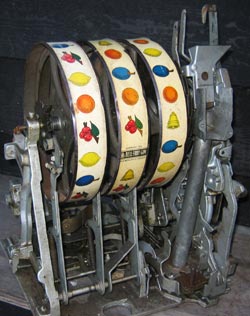
Millions of Naked Apes who before engaged their social skills began to watch the virtual dancing fruit. Before that there were mechanical slot machines.

16_inside-old-fruit-machine

Pretty much about the fruit, no?

And then there were video games…

And so it is that we all carry virtual fruit trees in our pockets and are compelled to consult them as if our next meal depended on them, which it might, in a virtual kind of way. We taste the apple any way we can. It is our heritage.

Posted in Anthropology, Biology, History of Life, Metaphor, PDA and the Apple of Eden, River | Tagged , , , , , | Leave a comment

The Dim Sum, Microbial Dark Matter and Wine Dark Seas

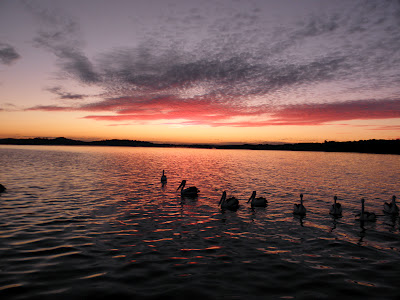
The oceans are a microbial soup I like to call the Dim Sum. It is an appropriate pun because it is both dim in the sense we don’t understand it, and  a dim sum in that we  cannot describe it mathematically. The oceans have chemical complexity nearly on the order of life. They are full of life as well, and microbial dark matter drives ocean chemistry in ways that make it difficult for us to distinguish the organic and inorganic chemistry. So all things considered, the oceans are rather like wine.pelican2

We have learned much of the chemistry of wine and much of the oceans as well, but our understanding of both remains as much art as science.

Astronomers tell us that dark matter comprises about eighty percent of the mass of the universe. We can’t see it, we don’t know anything about it except that calculations tell us it must be there. So it is with plankton. We can see some of them, but we don’t know anything about many of them because they are wild things that mysteriously resist our attempts to grow them alone in captivity.

darkmatter-c2fab3aeee04bf14cd3f92cfb5ac8fb5bced71c7-s6-c30

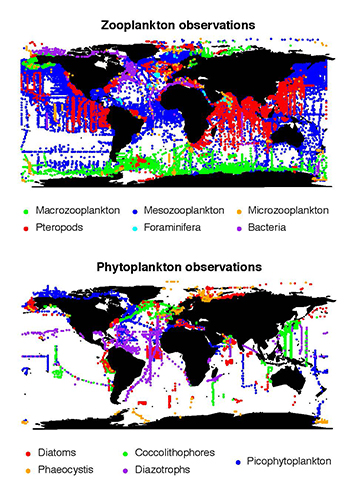
A dark matter “beach ball” above, the first Plankton Atlas below. Researchers were surprised that phytoplankton and zooplankton had equal mass in the upper ocean. Phytoplankton and zooplankton are the equivalents of plants and animals on land.

Mapvert350_294795

Is this some kind of a joke? Our knowledge of phytoplankton in 2013, in the Pacific Ocean, which covers roughly a third of the planet, is a couple of random transects? The sum gets dimmer.  One presumes they so much more interested in zooplankton because Forams are the touch stones of the ODP? How can you draw any general conclusion when the databases are so asymmetrical?

Check out zooplankton in the tropics. It shows alternating bands of Pteropods and Mesozooplankton. Overlooking for the moment that the line weights are oversized many orders of magnitude, does this strike you as real?

The sum remains dim, the matter remains dark, and our oceans remain as opaque to us as big red wines.

Posted in Biology, Geography, Microbial Dark Matter, Oceanography | Tagged , , , , , , | Leave a comment

A Quick Review of the Carbon Cycle

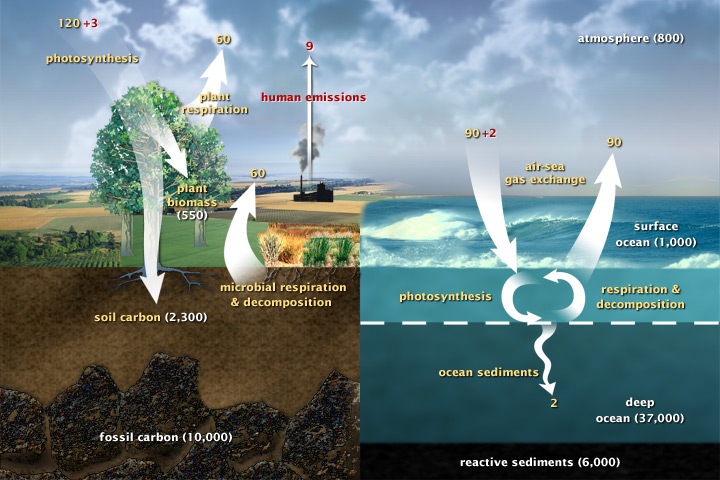
Quick review of the carbon cycle magnitude per NASA in Gt.:

Ocean to atmosphere 90
Microbial respiration land 60
Plant respiration land 60
Human 9
———
Total surface to atmosphere 219

Photosynthesis land 123
Atmosphere to Ocean 92
——-
Total atmosphere to surface 215

Photo Credit: NASA

Photo Credit: NASA

So if this is anywhere near right carbon should be accumulating in the atmosphere at about 4Gt/yr these days, less in the past, and likely more in the future.
While we sweat out the details of which sinks are pressure, temperature, pH, or chemically limited, it is worth bearing in mind the magnitude of the sinks. Temperature and partial pressure apply everywhere (albeit differently). Chemical and pH limitations apply mostly to the ocean which constitutes less than half of the total cycle. Chemical and pH constraints are predominantly inorganic.

Please notice that while lip service is given to photosynthesis and respiration in the photic zone of the ocean, no attempt is made to ascribe C flux values for these except the 2 Gt budgeted for carbonate rain. It is worth noting that carbonate precipitation actually increases pCO2 in the water as a result of the pH change.

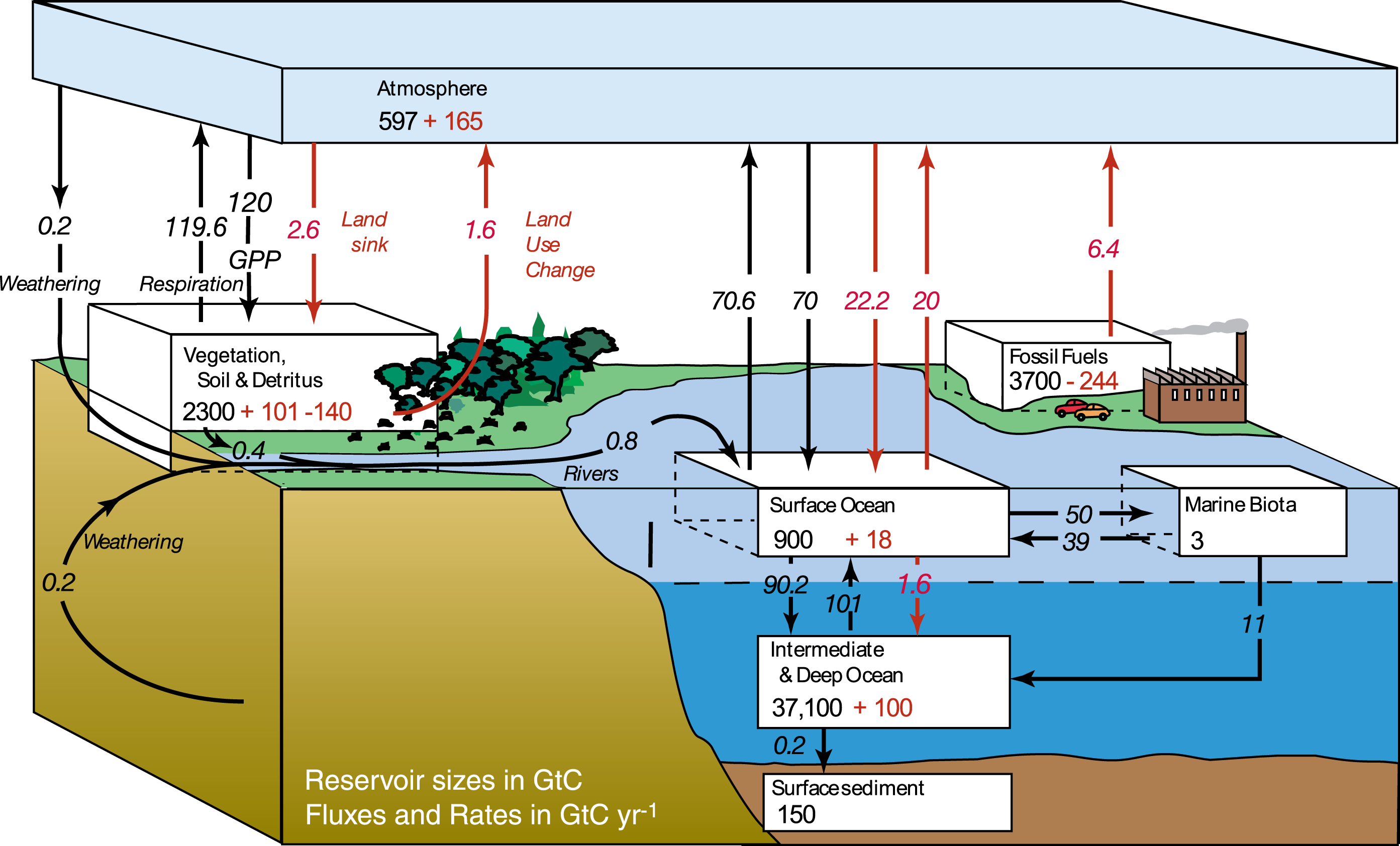
The entire carbon cycle on land is biological. Uptake will select against the heavy isotopes and output will be skewed to 12C. (Chemical weathering is not mentioned above and both silicate and carbonate weathering will be isotiopically blind on the atmosphere side, but the carbonate itself will be weighted light. As seen below the cycle budget for weathering may be only .5 Gt.)

There is another graphic from NASA that could be written off for its preposterous attribution of human influence, but nevertheless gets the overall numbers right and contains some more detailed information.

AnthropogenicCarbonCycleBox2

The ocean is the repository for biologically rejected isotopes. They travel by the rivers and the winds from land and also accumulate from biological rejection by plankton. Ocean sinks and sources are nearly half non biological (inorganic) and blind to isotopes.

Ferdinand Engelbeen says that 40Gt goes into (and presumably comes out of) the deep ocean so that leaves 50Gt of ocean flux that is probably biological. This agrees with the graphic above.

If this is right, 80% of the carbon cycle shares an isotopic signature similar to human production. This may mean that it will be very hard to ever know if the 9 human Gt out of the172 Gt total biological cycle are the very same ones causing the 4Gt current annual increase.

Posted in Carbon Cycle, Carbon Dioxide Loves to Swim, Climate Change, Geography, Oceanography | Tagged , , , , , | Leave a comment